Developing countries face a persistent financing gap of an estimated USD 2 to 4 trillion per year to meet climate and sustainable development objectives. While global capital is abundant, much of it remains concentrated in mature markets. In emerging and frontier economies, private investment continues to stall, held back by real and perceived risks, weak guarantees, currency volatility, and limited risk-sharing mechanisms.
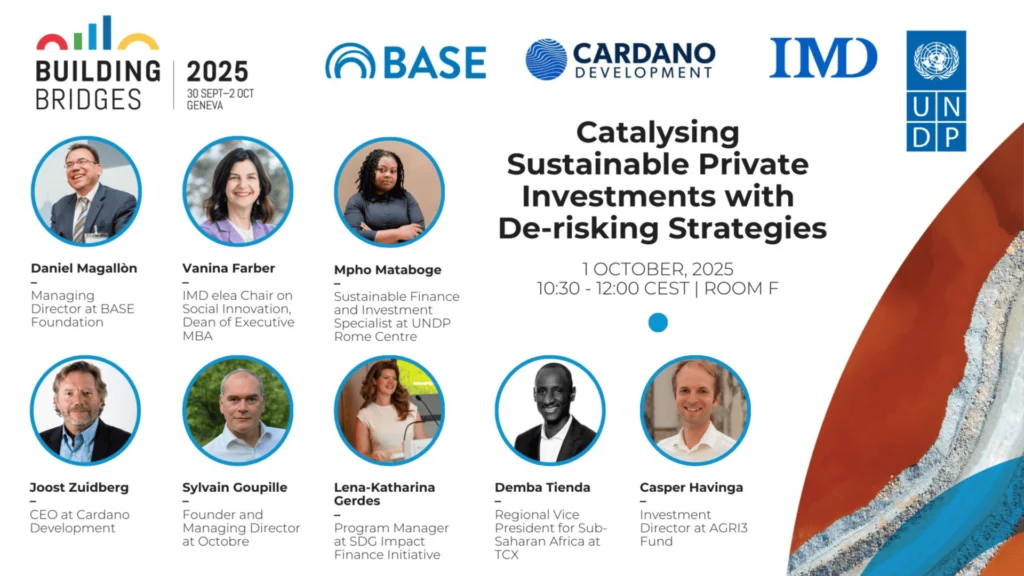
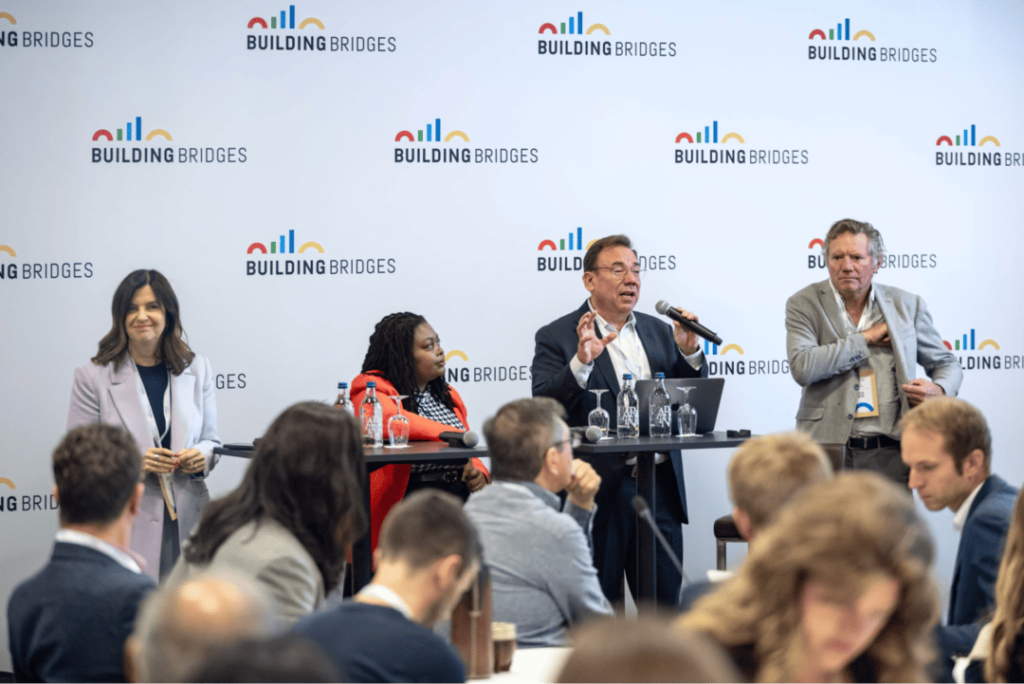
Against this backdrop, BASE, together with Cardano Development, the UNDP Rome Centre for Climate Action and Energy Transition, and IMD Business School, convened a dedicated session at Building Bridges 2025, titled Catalysing Sustainable Private Investments with De-risking Strategies to explore how de-risking strategies can unlock private investment for sustainable projects in emerging markets and developing economies. The session brought together around 100 practitioners from development finance institutions, donors, banks, insurers, fund managers, corporates, and project developers working across energy, agriculture, and nature-based sectors.
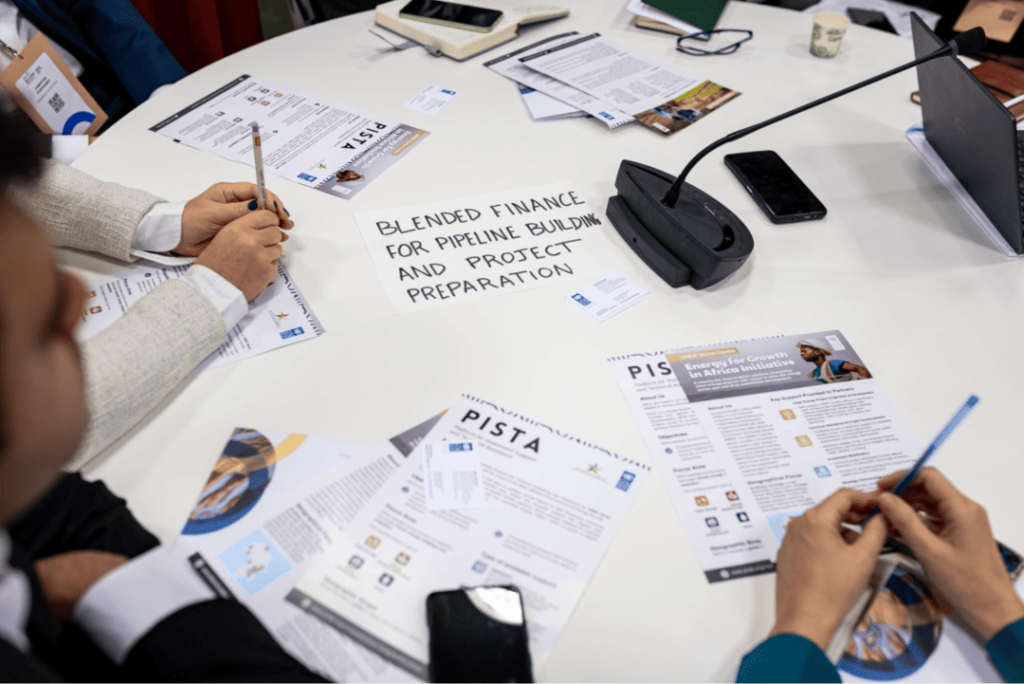
Following a World Café format, participants explored via roundtable discussions how tools such as guarantees, blended finance structures, grants and technical assistance, as well as insurance, derivatives, and currency hedging instruments, can shift project risk profiles and make investment viable.
This article aims to synthesise some of the main insights from the discussions and provide a set of shared challenges, concrete examples, and practical lessons on how de-risking strategies can be leveraged in a more effective and systemic way.
Three cross-cutting challenges identified by practitioners
Across the seven discussion tables, three structural challenges that continue to deter private investment in emerging and frontier markets emerged. These challenges cut across sectors and instruments and help explain why capital remains difficult to mobilise, even where projects appear technically sound.
1) Risk is often mispriced rather than inherently high.
A recurring theme was the gap between perceived and actual risk. Investors frequently demand high risk premiums or avoid certain markets altogether due to limited familiarity, weak data, or lack of internal expertise. Yet many participants pointed to evidence from impact portfolios showing relatively low default rates when projects are properly structured and supported. The issue is less the absence of viable opportunities than the absence of shared data, track records, and confidence. In this context, risk mitigation instruments play a critical learning role, allowing investors to build experience and recalibrate their risk models over time.
2) Projects that received technical assistance towards bankability are not always investable.
Another challenge lies in the disconnect between project preparation and investment decisions. Technical assistance facilities often deliver detailed feasibility studies, environmental and social assessments, and financial models, so projects meet formal preparation and compliance requirements. Yet many of these projects fail to reach financial close. Participants noted that the missing elements are often commercial rather than technical. Demand risk remains insufficiently addressed, revenue models are untested, and unit economics are rarely proven in real operating conditions. Investors look for evidence that a business model works with actual customers over time, not only that it works on paper. Without this operational proof, projects struggle to attract capital regardless of how complete their documentation appears.
3) Structural gaps limit effective risk-sharing at scale.
Finally, participants highlighted systemic failures in how risk is shared across the investment ecosystem. Illiquid markets and the absence of secondary transactions trap investors in long-term positions, reducing appetite for new allocations. Guarantees, insurance products, and currency hedging tools exist, but they are often fragmented, costly, or poorly aligned with the risks they are meant to address. As a result, risk mitigation is frequently applied in isolation rather than as part of a coordinated approach. This fragmentation limits scale and prevents otherwise viable projects from accessing the capital they need.
Together, these challenges point to a common conclusion: unlocking private investment requires more than individual instruments. It requires better alignment between project development, risk mitigation, and investor learning, supported by data, coordination, and realistic expectations of how markets mature.
Some of the key takeaways from the tables:
a) Credit and operational risk guarantees
During conversations led by representatives from Octobre, Cardano Development, and the AGRI3 Fund, credit and operational risk guarantees were discussed as one of the most widely used and best-understood de-risking tools available. At their core, guarantees reallocate a defined portion of risk from a lender or investor to a third party, often a development finance institution, donor, or philanthropic vehicle. By reducing potential losses on a specific risk, guarantees can make transactions feasible for institutions that would otherwise remain on the sidelines.
Participants were clear, however, that guarantees are not a substitute for sound project fundamentals. A guarantee cannot compensate for the absence of demand, a weak revenue model, or unrealistic assumptions. When used to support fundamentally unsound projects, guarantees merely shift inevitable losses to the guarantor. Their value lies instead in addressing uncertainty and information gaps where projects are viable but unfamiliar.
Case Study
A cited example was the guarantee programme developed by the Grameen Foundation in partnership with Crédit Agricole. In the early stages, Crédit Agricole’s local subsidiaries were reluctant to lend to microfinance institutions in Africa and Asia, viewing them as high risk despite limited evidence of default. To overcome this hesitation, Grameen provided a full credit guarantee on the initial loans, covering one hundred percent of potential losses. This protection allowed the bank to enter a new sector and observe actual performance rather than rely on assumptions.
As lending experience accumulated, defaults remained negligible. On the basis of this evidence, the guarantee coverage was progressively reduced, first to 50 percent, then to 25 percent, and eventually phased out entirely. Once the bank had built internal confidence and a track record, it continued lending without any guarantee support. The project fundamentals did not change. What changed was the lender’s understanding of risk.
b) Insurance and parametric solutions
Insurance was discussed on the table led by Vanina Farber, from the IMD, as a complementary risk mitigation tool rather than a primary driver of investment. Its role is to protect projects against low-probability, high-impact events once capital is deployed, not to compensate for weak fundamentals or uncertain demand. For this reason, participants emphasised that insurance works best when layered alongside equity, debt, and other de-risking instruments.
Parametric insurance has gained attention in emerging markets because it enables rapid payouts based on predefined triggers such as rainfall or wind speed, avoiding lengthy loss assessments. This can be particularly valuable where liquidity is needed quickly after a shock. At the same time, the challenge of basis risk remains significant. When triggers fail to reflect actual losses, trust can erode, making careful design and communication essential.
Several participants stressed the importance of piloting parametric products, combining them with complementary support for near-miss scenarios, and investing in user understanding of how triggers function. Without these elements, parametric insurance risks disappointing those it is meant to protect.
Case Study
An innovative case is the “Reef Insurance” piloted by The Nature Conservancy in Quintana Roo, Mexico, which was expanded in other Caribbean locales and more recently in Hawai’i, USA. Here, hotels and government pooled funds to buy a parametric insurance that pays out to fund reef restoration (like debris removal, re-attaching broken corals) if a hurricane of certain strength hits. The underpinning idea is that reefs protect the coastline (economic value in avoided damage), so insuring them and rapidly repairing them is economically justified. As coral can die within six weeks after a storm, funding needs to be available as fast as possible. Therefore, the insurance is triggered based on wind speed, which is measured in close to real time, rather than damage assessments. This is a nature-based parametric insurance use-case, essentially insuring an ecosystem service. It required creativity in setting triggers (hurricane wind speed in defined areas) and defining beneficiaries (the payout goes to a trust that hires restoration teams). This model is now cited for replication for mangroves, reefs, etc.
c) Foreign exchange (FX) hedging & currency risk
Currency risk is considered a major barrier to investment in emerging and frontier markets. Projects often generate revenues in local currency while financing is provided in hard currency, exposing borrowers and investors to exchange rate volatility, convertibility restrictions, and inflation-related shocks. These risks can quickly undermine otherwise viable projects and are difficult for individual investors to absorb.
Participants stressed the importance of distinguishing between different types of currency risk. Market volatility affects returns through depreciation, while convertibility and transfer risks arise from policy constraints and foreign exchange shortages. Each requires different mitigation approaches. In many cases, the cost of hedging remains prohibitive, particularly for long-term investments or currencies traded in low volumes, leading investors either to avoid local-currency exposure or to price it very expensively.
The discussions reinforced that currency risk mitigation is not only a financial issue but also a development one. Local-currency finance lowers default risk, improves affordability for end users, and supports the growth of domestic financial markets. When combined with other de-risking tools, it can play a critical role in moving projects from being technically sound to being genuinely investable.
Case Study
Specialised facilities that pool and mutualise currency risk were highlighted as an effective response. The TCX Fund is a central player, as it offers long-dated currency swaps in 100+ frontier currencies. TCX is capitalised by development finance institutions (DFIs) and donors and can provide, for instance, a 5-year swap from Ugandan shillings to USD, taking on the devaluation risk in exchange for a premium. Essentially, TCX (and similar facilities) mutualise FX risk across many currencies and investors, using its diversified portfolio and donor capital cushion to absorb losses if local currencies depreciate heavily. For example, if an impact fund lends in West African CFA francs, TCX will swap those cash flows into EUR for the fund; if the franc weakens more than expected, TCX’s pool bears that loss, meaning the fund’s return in EUR is protected (apart from the hedge premium). Without such hedges, many lenders either refuse local-currency exposure or charge prohibitively high interest rates to compensate for worst-case depreciation.
d) Blended finance and project readiness
Blended finance is often presented as a solution to bridge the gap between public objectives and private capital. Yet participants repeatedly noted that, in practice, many blended finance structures fail to mobilise investment despite significant concessional support. Technical assistance, grants, and structured vehicles are necessary, but they are rarely sufficient on their own.
A central issue discussed was the gap between project preparation and commercial reality. Many projects reach an advanced stage of technical readiness, with feasibility studies, financial models, and environmental and social assessments in place, yet still struggle to attract investors. The problem is rarely a lack of capital or instruments. Instead, it lies in unresolved demand risk, unproven unit economics, and limited operating track record. Investors are hesitant to commit capital where revenue assumptions have not been tested with real customers over time.
Participants stressed that technical assistance needs to be more tightly linked to commercial milestones. Rather than stopping at investment-readiness documentation, support should help projects validate demand, pilot business models, and generate early performance data. Without this evidence, projects remain theoretically “bankable” but practically uninvestable.
Timing also emerged as a recurring challenge. Funding windows for technical assistance and concessional capital are often misaligned with investor decision cycles or sector realities, particularly in agriculture and infrastructure. By the time projects are ready, investor priorities may have shifted, or capital allocations may no longer be available. This disconnect reduces the effectiveness of otherwise well-designed blended finance facilities.
The discussions suggested that blended finance works best when designed as a sequenced process. Early-stage concessional capital should absorb learning risk and support experimentation, while later stages should focus on crowding in commercial finance as uncertainty declines. Clear pathways for scaling and phasing out concessional support are essential if blended finance is to catalyse sustained investment rather than remain a series of isolated transactions.
In a nutshell…
The discussions at Building Bridges 2025 showed that reducing risk works best when it is practical, well-timed, and focused on real obstacles. Tools such as guarantees, insurance, hedging, and blended finance can help unlock investment, but only when they respond to the reasons capital is holding back. As projects prove themselves and markets develop, this support should gradually step back. When risk-sharing tools are combined thoughtfully and used to help investors learn, they can move beyond one-off deals and support investment at the scale needed for climate action and sustainable development.


