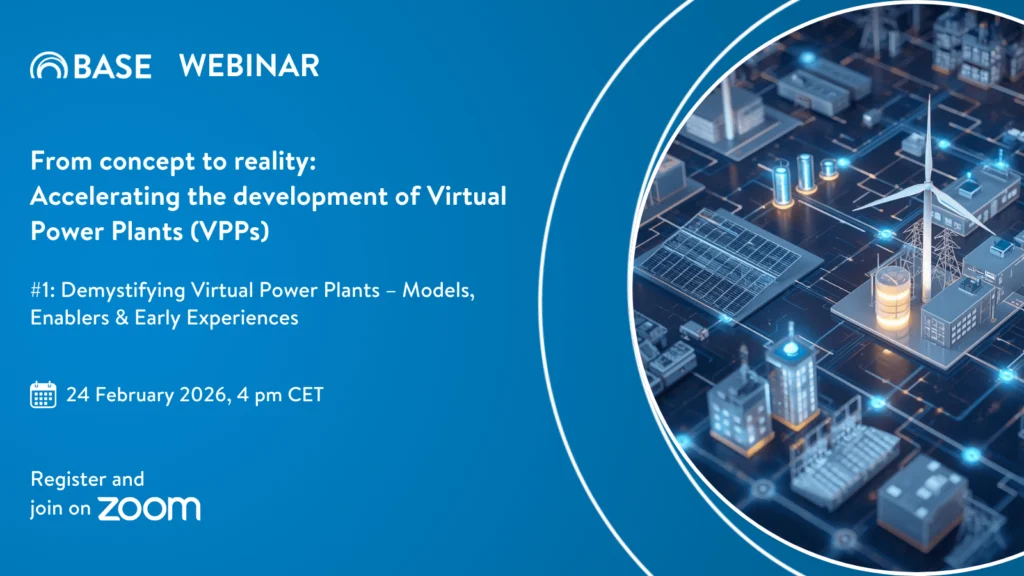
BASE Foundation will host an exclusive webinar on setting up Virtual Power Plants (VPPs), from pilots to large infrastructure, featuring experts and lead implementers from around the globe.
The session, planned on February 24 2026, will be part of a new webinar series convened together with Integrate to Zero “From concept to reality: Accelerating the development of Virtual Power Plants”, accessible virtually on Zoom.
The main objectives will be to explore the main current deployment challenges – from the regulatory environment to technological hurdles and financing – as well best practices and lessons learned from pioneers.
The series is designed to identify what it takes to make VPPs work on the ground in different regions of the world.
Setting the Stage
Electricity systems are quickly evolving, no longer defined solely by power plants and transmission lines. Across the world, energy is increasingly produced, stored, and consumed at the edges of the grid. Rooftop solar panels now sit atop homes and factories, batteries are becoming commonplace, and electric vehicles are quietly turning into mobile energy assets. These distributed energy resources are quietly but fundamentally changing the energy landscape.
Yet a central question remains: how can thousands of small, decentralised systems owned by different individuals and businesses be coordinated in a way that strengthens the grid rather than complicates it?
Virtual Power Plants (VPPs) offer one of the most convincing answers to date. VPPs connect dispersed energy resources via a digital platform, leveraging state-of-the-art technologies such as machine learning for predictive energy generation and consumption analytics, and complex algorithms to dispatch energy to thousands of endpoints under management simultaneously.
This central control system allows them to operate as a single, flexible network. For consumers, this opens the door to active participation in energy markets, and becoming “prosumers”. For utilities and system operators, it offers a way to access flexibility without relying on new fossil-based infrastructure. While the promises are clear, the reality, particularly in emerging markets, tends to prove more complex.
About the session
The first webinar of the series, “Demystifying Virtual Power Plants: Models, Enablers and Early Experiences” draws directly on pilot projects supported by BASE and Integrate to Zero in Latin America, as well as Octopus Energy pioneering work in the United Kingdom, where the company orchestrate one of the world’s largest residential virtual power plants.
By joining the webinar, you will hear stories and insights from:
Integrate to Zero and their VPP Readiness Assessment Tool, co-developed with Blunomy, which evaluates countries’ preparedness to deploy VPPs at scale based on technical, regulatory, and commercial characteristics. By assessing nine criteria across five categories, such as resource availability, market attractiveness, and regulatory environment, the tool helps policymakers and investors identify the specific reforms needed to turn distributed energy resources into viable grid assets.
Auren Energia and the pilot in Brazil developed with GreenAnt. The project uses data simulations to understand how aggregated energy resources from residential, commercial, and industrial consumers can participate in Brazil’s Demand Response (DR) programmes, which help stabilise the grid via the voluntary reduction of electricity use. Aiming to demonstrate how VPPs can generate revenue and manage surplus electricity feed-in, the results point to strong potential in the Southeast while revealing regulatory constraints, such as minimum bid thresholds, that limit participation by smaller aggregators and slow market diversification.
Celsia Energia and the Colombia pilot, focusing on integrating decentralised energy assets like rooftop solar and battery systems into a unified digital platform that can dynamically manage power supply and demand. This VPP pilot leverages real-time optimisation to support grid balancing, frequency control, and load shifting. As a result, customers benefit from lower energy bills, while the grid benefits from greater flexibility and stability. The first phase used a laboratory environment to conduct the technical tests and technological developments with a minigrid, laying the groundwork for a real-world implementation with local customers as part of the ongoing second phase.
Octopus Energy and the United Kingdom VPP, one of the largest privately run VPPs in the world. Through its Kraken platform, based on advanced data and machine learning capabilities enabling the management of DERs in a VPP system, Octopus Energy now orchestrates over 2 GW of flexible capacity across electric vehicles, home batteries, heat pumps, and solar systems, flattening peak demand and lowering system costs. The platform connects more than 500,000 devices and delivers significant consumer savings by automatically shifting energy use to lower-demand periods. Octopus’s contribution will share lessons from mature markets, providing insights on customer engagement and cutting-edge digital platforms and how to bring Virtual Power Plants from pilots to mainstream infrastructure.
Missed the live sessions? Watch the replay of our session on Virtual Power Plants:
Speakers presentations are accessible here.
Sign up for our newsletter to receive updates on future events here.


