BASE was at the inaugural Global Cooling Pledge Assembly in Singapore, which took place between 15 and 18 September 2026. Co-hosted by the UN Environment Programme (UNEP) Cool Coalition and Singapore’s Ministry of Sustainability and the Environment, the Assembly brought together more than 230 delegates from governments, cities, industry, development finance institutions and technical partners, with 60 countries represented. Its purpose was a practical one: to move the Global Cooling Pledge from commitment towards delivery.
Launched at COP28 in 2023, the Pledge commits its signatories to reduce cooling-related emissions by at least 68 percent relative to 2022 levels by 2050, while expanding access to sustainable cooling. The Singapore Assembly saw the number of signatories rise to 76, hosted the first formal meeting of the new Intergovernmental Committee on Cooling and launched a Manufacturing Platform connecting governments with equipment makers. It also presented the first Cool Leaders awards to Singapore, the United Arab Emirates and Dong Mingzhu, Chairwoman of Gree Electric Appliances. Finance ran through many of the discussions, and the Assembly’s summary report names Cooling-as-a-Service among the approaches that can help turn national cooling priorities into investable projects.
A long-standing commitment to clean cooling
As an endorser of the Global Cooling Pledge, BASE shares its ambition, and its own contribution sits in the part of the problem that technology alone cannot solve: how efficient cooling gets paid for. Space cooling already accounts for roughly 10 percent of the world’s electricity consumption, and demand is growing fastest in hot, rapidly urbanising regions such as Southeast Asia. More efficient systems running on natural or low-global-warming-potential refrigerants are available, yet they cost more upfront and are more complex to operate, so most building owners buy a chiller plant outright and keep it running for as long as they can.
Cooling-as-a-Service (CaaS) changes that calculation. Instead of purchasing equipment, the customer pays for the cooling it uses, against agreed performance targets, while a dedicated provider designs, finances, installs, owns, operates and maintains the plant for the length of the contract. Because the provider earns its revenue from the service it delivers rather than from the sale of equipment, its interest lies in installing efficient systems and keeping them running well, and the customer avoids a large capital outlay.
BASE has worked for years to bring this innovative business model into the mainstream. In January 2026, that work was recognised with the Zayed Sustainability Prize in the Energy category. The USD 1 million prize fund will support BASE in continuing to deploy Cooling-as-a-Service worldwide, with expansion planned across Africa, Asia, Europe, the Middle East and Latin America.
A programme built around Cooling-as-a-Service
Alongside the official Assembly, BASE and the Servitisation for Energy Transition (SET) Alliance – the global platform BASE founded in 2022 to scale service-based models for the energy transition – organised a series of activities with partners Kaer and Danfoss, including masterclasses and site visits.
On the evening of Thursday, 17 September, participants visited the central chiller plant serving the Chinatown Point shopping centre, where Kaer has delivered Cooling-as-a-Service since 2017. Attendees were able to see its cooling infrastructure, advanced controls and KaerAI platform in operation. Danfoss also hosted a visit to its regional Sustainability Technology Center, which showcases decarbonisation solutions for tropical cities, followed by a reception with welcoming remarks from the Ambassador of Denmark to Singapore, BASE and Danfoss.
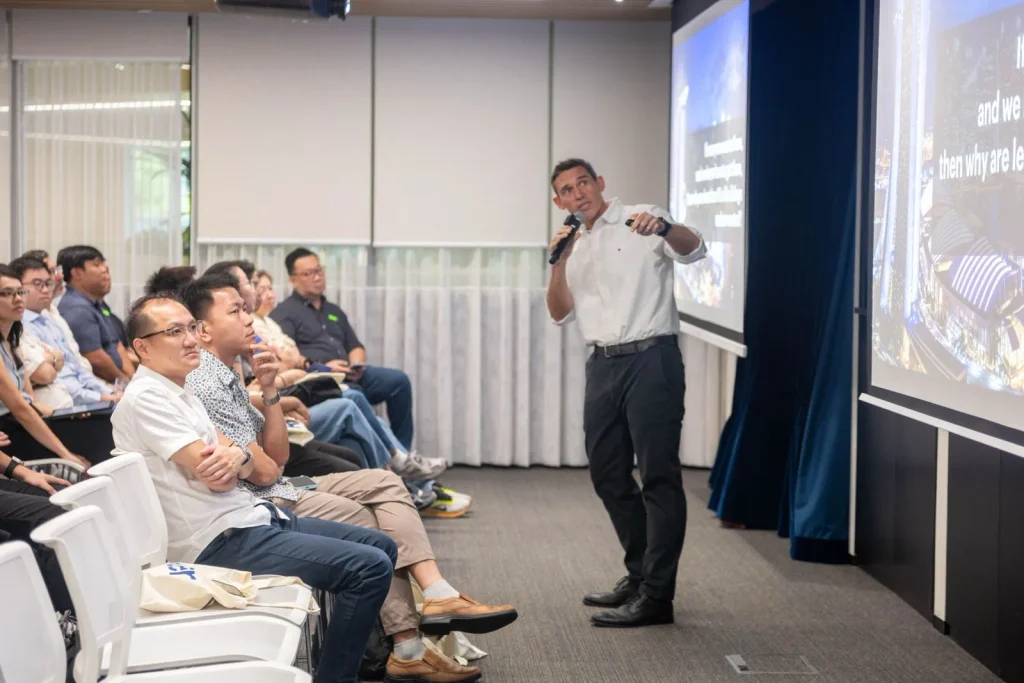
On Friday, 18 September, the SET Alliance delivered two masterclasses for more than 120 participants. The audience combined Singaporean public and private actors, including building owners, engineering consultants, project developers, asset managers and financiers, with official delegates from governments and international organisations attending the Assembly. The morning session offered an introduction to CaaS tailored to the private sector and to regional conditions. The afternoon session paired a short introduction to the model with masterclasses on district cooling and data centres led by Danfoss, and closed with the signing of a Memorandum of Understanding with Singapore to scale sustainable cooling solutions.
The discussions stayed close to practice: how service-based models address the barriers of upfront cost and uncertain performance, what makes a CaaS structure bankable, and how the model interacts with technology selection, monitoring and the contractual allocation of risk. One lesson echoed the wider Assembly: Cooling-as-a-Service is a proven model, but it scales only when policy, technical delivery and financing are designed together, meaning regulation that recognises service-based contracts, delivery that is measured on performance, and financiers who regard pay-per-use cooling as bankable.
The Asian CaaS Toolkit
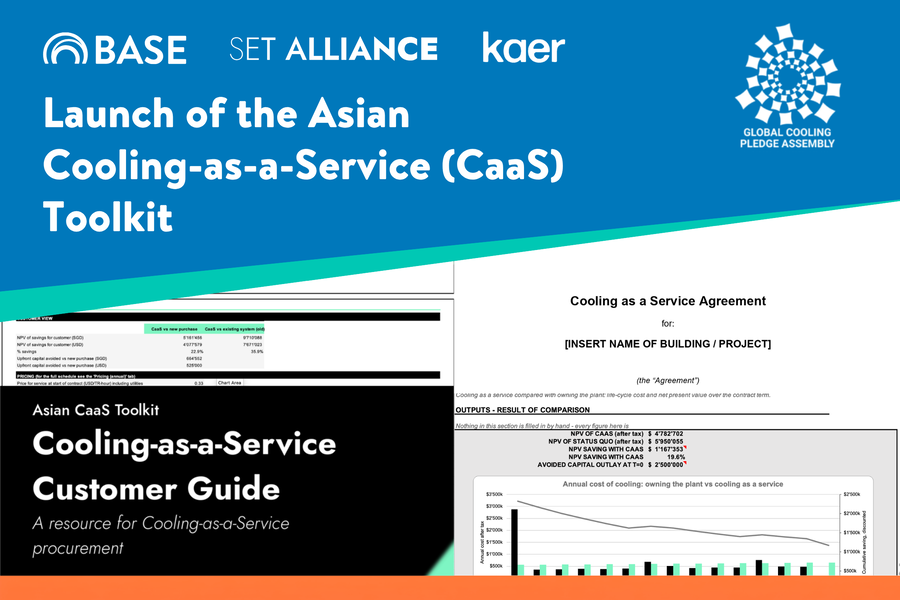
Both masterclasses marked the launch of the Asian CaaS Toolkit, developed by the SET Alliance with long-standing industry partners Kaer, a CaaS pioneer active across Southeast Asia and India, and Energy Partners Refrigeration.
Cooling-as-a-Service providers already operate in India, Indonesia, Malaysia, Singapore and Vietnam, where their projects reduce energy use and contribute to green building certification. Making the model work at scale across a region where laws, currencies and climates differ from one country to the next is another matter. Facility managers, building owners, procurement officers and consultants currently have no standard way of requesting or evaluating bids, and little guidance on how to read a commercial proposal. The toolkit is designed to give actors across the building and real estate value chain that common foundation. It comprises four elements:
- Customer Guide and Request for Quotation template. The guide explains what CaaS is, why it matters in the region and which sectors it suits, sets out the stages of procurement, and suggests questions for comparing proposals. The tender template lets building owners and managers specify their cooling needs, equipment and performance requirements, and obtain comparable quotes from providers.
- Standardised CaaS Contract. Because CaaS transfers certain risks from customer to provider, the contract sets out how those risks are shared, through suggested clauses that reflect industry practice and input from Kaer and Energy Partners Refrigeration. Its explanatory notes guide both parties through the main negotiation points towards a fair and balanced agreement, and a checklist supports adaptation to national law.
- Comparison of the models. A two-page overview setting Cooling-as-a-Service side by side with the conventional approach of buying and owning the equipment.
- Economic and Pricing Model. Available in two versions. A simpler customer review tool lets providers show a customer planning to replace its cooling how a CaaS offer compares with buying new equipment, based on cooling demand, efficiency, electricity tariffs and equipment price. A more detailed version adds the customer’s current operation as a third scenario and shows how factors such as financing shape the CaaS fee, helping financiers assess project viability and providers run sensitivity analyses.
The toolkit’s technical and legal content is designed for commercial and industrial projects, and it fits with rules already in place across the region, including Singapore’s Green Mark and Malaysia’s Green Building Index certifications, as well as the international rules phasing out harmful refrigerants.
Each group of users gains something different. Facility owners and their advisors, such as commercial building owners, mall operators, hospital administrators and managers of data centres and industrial plants, can request competitive bids without committing capital upfront, compare CaaS proposals against a conventional purchase on the same cost basis, and allocate risk in a way that protects their operations. Technology and service providers, including chiller manufacturers, energy service companies and specialised cooling operators, can work from clear scoping definitions, understand what a request for quotation expects of them and explore how to price their offer. Financiers, from commercial banks to special purpose vehicles and impact funds, can test the assumptions behind CaaS as a financing structure and gain a clearer view of its risks.
Access the toolkit
The toolkit aims to offer a shared starting point, so that each new project in the region need not begin from a blank page.
The Asian CaaS Toolkit is available on the SET Alliance website.


